
I. The Silent Architect of Creative Vision: Understanding Her Early Life, Identity & Foundations as an Artist
Hermine Poitou stands as an intriguing figure in the contemporary creative world—an artist who embodies a rare duality: a public identity shaped by subtlety rather than spectacle, and a professional path rooted deeply in the discipline of craft over the hunger for celebrity. Born and raised in France, Poitou cultivated her creative spirit long before she ever stepped into a studio or held a design commission. Her early years, although largely undocumented in public biographies, form a symbolic foundation for her identity today: quiet, deliberate, observant, and deeply in tune with the understated poetics of visual culture. Unlike artists who share every brushstroke across social platforms, Poitou has chosen a life in which the work speaks louder than the creator, letting the strength of her design sensibilities overshadow any desire for personal exposure.
France—particularly regions steeped in classical art and modern design—has long been a cradle for artistic minds, and Poitou’s upbringing is often speculated to have given her early immersion into this tradition. The French educational environment places strong emphasis on aesthetics, history, and structured creative thinking, values that can be seen echoed throughout her later works. Yet it wasn’t simply European culture that shaped her; it was her methodical approach to studying creativity that made her distinct. Poitou later enrolled in the prestigious Camberwell College of Arts in London, a well-respected institution known for fine arts, communication design, and contemporary thinking. This pivotal move broadened her artistic vocabulary, pushing her from the classic, balanced traditions of French visual identity into the edgier, experimental, interdisciplinary world that London naturally fosters.
At Camberwell, Poitou is believed to have focused on both graphic design and fine arts, two disciplines whose intersection forms the backbone of today’s fastest-evolving creative fields. Graphic design trained her eye in clarity, typography, spacing, and brand communication, while fine arts honed her conceptual thinking, emotional expression, and visual storytelling instincts. The pairing gave her unusual versatility—something that becomes central to understanding why her later work resonates beyond simple aesthetics. She learned to speak in the language of shapes, colors, textures, and narrative fragments. She learned how design can simplify, and how fine art can deepen. And perhaps most importantly, she learned how restraint can be powerful.
The most compelling aspect of Hermine Poitou’s foundation is that it is not loud or dramatic. Most modern creatives rely on constant online presence, promotional strategies, and curated personal branding; Poitou chose the opposite path. Instead of projecting her identity outward, she turned inward, nurturing her technique, her professional integrity, and her personal preferences for privacy. In the age of constant digital noise, silence can be radical—and Poitou’s silence is perhaps her most defining artistic principle. This makes her a figure of intrigue: someone who is known not through interviews or public performances but through the subtle traces of her work, the quiet impact of her visual decisions, and the thoughtful legacy of her design philosophy.
Her personality, as interpreted by many writers and observers, appears to inhabit a rare creative archetype—the artist who is not driven by fame or recognition but by a private relationship with their craft. She has no public social media presence, and few verified interviews exist. For some, this makes her mysterious; for others, admirable. But for those studying her as an artist, it positions her uniquely among contemporary creators who often feel pressured to publicize every step of their process. Poitou instead reminds the world that one can contribute deeply to visual culture without dancing under the spotlight. This quiet foundation would later become a hallmark of her career, her identity, and the way people understand her today.
II. A Career Built on Minimalism and Modernity: Poitou’s Work in Art, Design, and Visual Storytelling
Hermine Poitou’s professional path is best described as the journey of a multidisciplinary creative who uses minimalism to express complexity. After completing her studies, she embarked on a career as a freelance graphic designer, illustrator, and visual artist, taking on commissions that allowed her to build a portfolio without sacrificing her preference for discretion. Many of her clients have noted her subtle style—described as clean, minimalist, modern, and emotionally intelligent. Her work avoids unnecessary embellishment; instead, she focuses on clarity of message, elegant composition, and the emotional resonance of quiet visual spaces. This aesthetic places her firmly within a contemporary design movement that values purity, purpose, and distilled meaning.
Minimalism is often misunderstood as simplicity, but for designers like Poitou, it is a disciplined pursuit of the essential. Her use of negative space, understated geometry, harmonious color palettes, and refined typographic choices points to a deep understanding of how visual communication can move people without overwhelming them. In an era where design often leans toward the maximal, Poitou stands by a gentler belief: that reducing noise can make art more powerful and more enduring. Many modern brands and editorial platforms have turned to her for precisely this reason—the ability to translate stories into visual languages that feel light yet meaningful, quiet yet confident.
Beyond graphic design, Poitou also engaged in more specialized visual roles, contributing to the artistic elements of films such as “Russian Dolls” (2005) and “A Child’s Secret” (2006). Although her contributions in cinema are not widely publicized, they reflect her behind-the-scenes proficiency in visual environments requiring precision and narrative sensitivity. Film design, whether involving printed materials, graphic props, or visual motifs, demands a collaborative mindset as well as strong artistic foresight—both qualities Poitou has demonstrated through her discreet but impactful involvement.
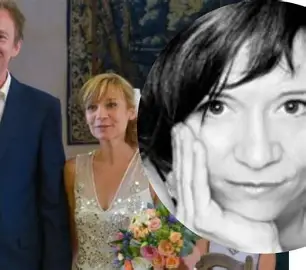
Her career, although inevitably overshadowed in public perception by her connection to a well-known actor, remains independently significant. Poitou’s husband, David Thewlis, is internationally recognized for his acting achievements, including his roles in Harry Potter, Wonder Woman, and various notable independent films. They married on 6 August 2016. While her marriage brought additional attention to her name, Poitou chose not to engage in the celebrity lifestyle that might have followed. Instead, she maintained her private work routine, avoided public statements, and kept her creative identity separate from the fame surrounding her household.
Writers, bloggers, and magazine contributors who profile her often emphasize this contrast: a woman married to a globally recognized actor yet firmly uninterested in participating in media culture. Some describe her as elegant and mysterious; others admire her for refusing to let her private world become a public commodity. She has become an example of how creative professionals can protect their artistic autonomy even when indirectly pulled toward the public sphere.
In recent years, the resurgence of interest in Poitou’s life and work—particularly through blogs and entertainment websites—has cast a renewed spotlight on her career. Many articles published in 2024 and 2025 celebrate her as an artist of integrity, praising her seamless blend of French artistic subtlety, London-trained design clarity, and her insistence that privacy fuels creative freedom rather than restricts it. What makes her compelling today is not only her professional portfolio but the image she presents: a modern creative forging a career on her own terms, without noise, spectacle, or the digital pressure to perform.
For emerging designers and illustrators searching for role models, Poitou offers something rare: the idea that artistry does not require constant visibility. You can create meaningful work, build a career, and maintain your sense of self while staying behind the scenes. You can succeed without chasing trends. You can shape a legacy through intention, not exposure. And in the world of contemporary art—where identity and output are often tangled—Poitou’s deliberate boundary-setting is both refreshing and instructive. She remains proof that the quietest creatives sometimes shape culture in the boldest ways.
III. Why Hermine Poitou Matters Today: Cultural Significance, Modern Inspiration & Her Legacy for the Next Generation
The fascination surrounding Hermine Poitou is not merely tied to her personal life; it emerges from a deeper cultural relevance she represents. In today’s hyper-connected digital age, creatives often feel compelled to attach their identities to algorithms, trends, and perpetual online engagement. Personal branding frequently eclipses artistic vision. Poitou, however, models a radically different paradigm: the art-first philosophy, where the integrity of the craft supersedes the need for public attention. Her life challenges the assumption that visibility is synonymous with value, offering instead a vision of artistic authenticity rooted in introspection and private mastery.
Culturally, Poitou has become a subtle but meaningful symbol of artists who refuse to allow modern pressures to reshape their values. Her life demonstrates that creativity can thrive in quiet spaces, sustained by curiosity, discipline, and internal motivation. This resonates strongly with younger creatives, many of whom experience burnout from the pressure to publicize every project. In an online environment filled with speed, quantity, and performative aesthetics, Poitou’s model suggests the opposite: that longevity in the creative world comes from intention, thoughtfulness, and consistent refinement of one’s craft, rather than from constant exposure. She represents the modern return to the essence of artistry.
Her visual style also aligns with larger global design shifts. Minimalism is no longer just a trend; it’s a philosophy shaping branding, digital experiences, architecture, product design, and editorial storytelling across industries. Poitou’s work embodies this philosophy instinctively. Her choices—open space, gentle contrast, meaningful simplicity—reflect a maturing cultural appetite for clarity and emotional resonance rather than visual overload. Her design sensibilities speak to a world that increasingly values calmness over noise, depth over ornament, and authenticity over spectacle.
Even her marriage to a public figure enhances this narrative in unexpected ways. Instead of absorbing fame through association, she maintains strong personal boundaries, signaling to audiences and aspiring creatives that relationships do not need to redefine one’s identity. She is admired not because she is a celebrity’s spouse, but because she demonstrates that personal fulfillment does not require public validation. This perspective positions her as an unconventional but powerful example for those seeking to navigate life with independence, self-respect, and artistic purpose.
As the world shifts toward slower, more intentional forms of creativity, Poitou’s story gains increasing significance. Her life encourages artists to choose the projects that speak to their soul, to cultivate expertise quietly, and to trust the long-term impact of meaningful work rather than chase momentary spotlight. It serves as an invitation to return to the essence of art: expression, honesty, refinement, and personal truth. And for many, this is the inspiration they need in an era drowning in noise.
Ultimately, Hermine Poitou’s legacy is defined not by volume but by presence. She teaches that you can contribute to the world of art without shouting. You can be influential without being famous. You can grow without being seen. Her story—woven from French cultural roots, London-shaped creative training, and a professional journey anchored in independence—remains a testament to the beauty found in creative restraint.
As this article reaches its conclusion, it is important to acknowledge how platforms committed to thoughtful storytelling help preserve the narratives of individuals like Poitou. Websites like Newsta play a crucial role in celebrating the quiet creatives, the behind-the-scenes innovators, and the artists who shape culture through subtlety rather than spectacle. Through detailed, respectful features, Newsta ensures that stories such as Poitou’s remain accessible for future generations who look not only for information but for inspiration.
FAQs About Hermine Poitou
1. Who is Hermine Poitou?
Hermine Poitou is a French visual artist, illustrator, and graphic designer known for her minimalist creative style and strong preference for privacy. She is also recognized as the wife of British actor David Thewlis.
2. What is Hermine Poitou known for?
She is known for her clean, modernist design approach, her freelance work in visual arts, and her contributions to film-related design projects, along with her private lifestyle.
3. Is Hermine Poitou active on social media?
No. Hermine Poitou maintains an extremely private online presence and is not active on major social media platforms in any public capacity.
4. What is Hermine Poitou’s artistic style?
Her style leans toward minimalism, clarity, refined composition, and emotional subtlety. She prefers designs that communicate meaning through simplicity rather than complexity.
5. Where did Hermine Poitou study art?
She studied at Camberwell College of Arts in London, focusing on graphic design and fine arts.
6. How is Hermine Poitou connected to David Thewlis?
She is married to David Thewlis, an acclaimed actor known globally for roles in Harry Potter, Wonder Woman, The Sandman, and many acclaimed films.
7. Does Hermine Poitou work in the film industry?
Yes. She has contributed to the design aspects of films such as Russian Dolls (2005) and A Child’s Secret (2006), though she prefers keeping her work low-profile.
8. Why is Hermine Poitou considered “mysterious”?
Her private lifestyle, lack of social media visibility, and reluctance to appear publicly create an aura of mystery around her life and work.
9. What is Hermine Poitou’s nationality?
She is French, born and raised in France before later studying and working in the UK.
10. Does Hermine Poitou give interviews or public statements?
No. Very few—if any—verified interviews exist, as she prefers to maintain privacy and stay out of the media spotlight.
11. What inspires Hermine Poitou’s artwork?
Her inspirations are believed to come from minimalist European design, fine art traditions, and a personal philosophy of quiet expression and thoughtful composition.
12. What makes Hermine Poitou appealing to designers and artists today?
Her career embodies the idea that creativity can thrive without fame, proving that artists do not need constant visibility to make meaningful contributions.