Tungsten (Wolfram): A Complete Guide to Properties, Uses, Price, and Industrial Importance

Introduction
Tungsten, also known as wolfram, is one of the most remarkable metals in the periodic table. Renowned for its extreme hardness, very high density, and the highest melting point of any metal, tungsten plays a critical role in modern industry and technology. From cutting tools to aerospace engineering, its unique properties make it indispensable.
This comprehensive article explores tungsten in detail, including its symbol, physical properties, uses, pricing, and answers to common questions such as whether it is called tungsten or wolfram.
What is Tungsten (Wolfram)?
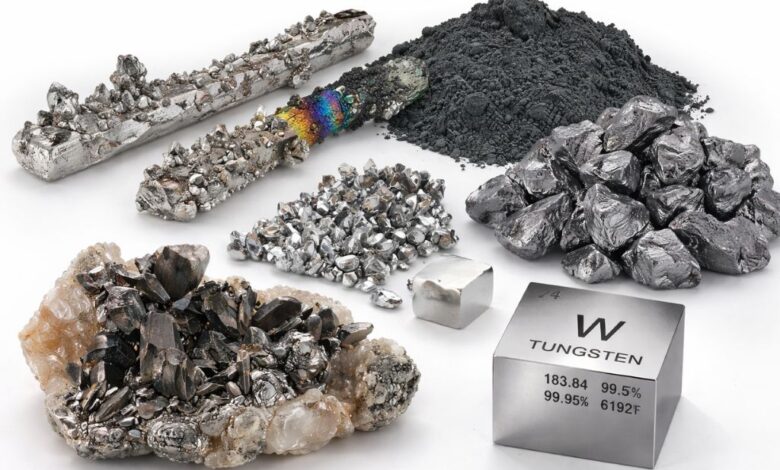
Tungsten is a chemical element with the symbol W and atomic number 74. It belongs to the group of transition metals and is widely known for its durability and resistance to extreme temperatures.
The element has two commonly used names:
- Tungsten – the standard English name
- Wolfram – used in many European languages
The term “volfram” is simply a misspelling of “wolfram.” Both tungsten and wolfram refer to the same element, which is why its chemical symbol is W.
Tungsten Symbol and Key Properties
| Property | Value |
|---|---|
| Symbol | W |
| Atomic Number | 74 |
| Atomic Mass | 183.84 |
| Density | 19.3 g/cm³ |
| Melting Point | 3422°C |
| Boiling Point | 5555°C |
Tungsten’s melting point of 3422°C is the highest among all metals, making it ideal for applications involving extreme heat.
Tungsten Density and Physical Characteristics
Tungsten has a density of approximately 19.3 g/cm³, which is nearly equal to gold and significantly higher than most other metals.
Key physical features:
- Extremely dense and heavy
- High tensile strength
- Resistant to corrosion
- Maintains strength at high temperatures
Because of these characteristics, tungsten is widely used where both strength and weight are essential.
Tungsten Uses in Modern Industry
Tungsten’s unique properties allow it to be used across a wide range of industries:
1. Electrical and Electronics
- Light bulb filaments
- Cathode ray tubes
- Electrical contacts
2. Industrial and Manufacturing
- Cutting tools
- Drill bits
- Heavy machinery components
3. Aerospace and Defense
- Rocket engine parts
- Heat shields
- Armor-piercing applications
4. Alloys and Metallurgy
- High-speed steel
- Superalloys used in turbines and engines
Its ability to withstand extreme conditions makes tungsten a key material in advanced engineering.
Tungsten Carbide: One of the Hardest Materials
Tungsten carbide is a compound formed by combining tungsten with carbon. It is widely recognized for its exceptional hardness and durability.
Properties of Tungsten Carbide:
- Extremely hard (close to diamond hardness)
- Highly wear-resistant
- Long-lasting under stress
Applications:
- Cutting and drilling tools
- Industrial equipment
- Jewelry (scratch-resistant rings)
Tungsten carbide is essential in industries where durability and precision are required.
Tungsten Price (Per Kilogram)
The price of tungsten depends on factors such as purity, form, and market demand.
Typical price ranges:
- Raw tungsten: $50 – $80 per kg
- Tungsten carbide: $40 – $70 per kg
- High-purity tungsten: $200 – $800+ per kg
What is the price of 1 kg tungsten?
On average, 1 kg of tungsten costs between $50 and $150, though specialized forms can be much more expensive.
Prices may fluctuate due to supply chain conditions, mining output, and industrial demand.
Who Discovered Tungsten?
Tungsten was discovered in 1783 by Spanish chemists known as the Elhuyar brothers. Their discovery significantly contributed to the development of metallurgy and industrial materials.
Tungsten Cube: A Demonstration of Density
A tungsten cube is often used to demonstrate the metal’s extraordinary density.
Interesting facts:
- A small cube feels surprisingly heavy
- A 1-liter tungsten cube weighs about 19 kilograms
- Popular in science demonstrations and educational displays
These cubes visually and physically demonstrate how dense tungsten really is.
Is Wolfram a Heavy Metal?
Yes, tungsten (wolfram) is classified as a heavy metal.
Reasons:
- High density (19.3 g/cm³)
- Large atomic mass
- Strong atomic structure
It is one of the densest naturally occurring metals and is widely categorized among heavy transition metals.
Is it Volfram or Tungsten?
The correct terms are:
- Tungsten (English)
- Wolfram (European usage)
“Volfram” is incorrect and is simply a spelling mistake. Both correct names refer to the same chemical element with the symbol W.
Conclusion
Tungsten, or wolfram, is a vital metal in modern industry due to its unmatched melting point, high density, and exceptional strength. Whether used in industrial machinery, electronics, or aerospace applications, it continues to be a cornerstone material for advanced technologies.
Its versatility, durability, and unique physical properties ensure that tungsten will remain an essential resource for future innovations.
Frequently Asked Questions (FAQs)
What is the tungsten symbol?
The symbol of tungsten is W.
What is the melting point of tungsten?
It is approximately 3422°C, the highest of all metals.
What is tungsten used for?
It is used in tools, electronics, aerospace components, and alloys.
What is tungsten density?
The density of tungsten is 19.3 g/cm³.
What is tungsten carbide?
It is a very hard compound made from tungsten and carbon, used in cutting tools.
What is the price of 1 kg tungsten?
Typically between $50 and $150, depending on quality and form.
Who discovered tungsten?
The Elhuyar brothers discovered it in 1783.
Is tungsten a heavy metal?
Yes, tungsten is classified as a heavy metal due to its high density and atomic mass.