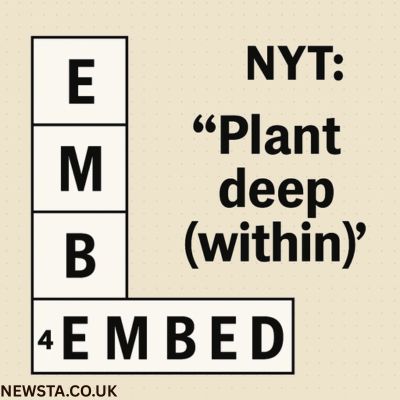
Crossword puzzles have long fascinated language lovers for their blend of logic, pattern recognition, and wit. The New York Times Mini Crossword is particularly known for condensing all this cleverness into small, daily puzzles. One clue that recently caught the attention of solvers was “Plant deep (within)” — short, simple, but deceptively layered.
This clue appeared in the NYT Mini Crossword published on September 20, 2024, and its official answer was EMBED. While the word itself is common in both language and technology, the way it fits the clue illustrates the brilliance of NYT’s puzzle constructors.
In this article, we’ll unpack the answer, analyze how crossword clues like this are designed, explore similar examples, and discuss why it has become such a searched-for phrase online.
1. The Clue and Its Answer
When solvers saw “Plant deep (within)”, the first instinct for many was to think of gardening — perhaps sow, bury, or root. But the NYT Mini is rarely that straightforward. Its clues often play on double meanings or figurative usage.
The answer EMBED fits perfectly once we consider the broader, metaphorical sense of the word “plant.” To embed something means to fix it deeply and securely within something else — like embedding an image into a webpage, or embedding an idea into someone’s mind.
The parenthetical phrase “(within)” reinforces that internal sense. The clue isn’t talking about soil or seeds at all, but about placing something firmly inside another structure or medium.
So the logic works like this:
- “Plant” → to place or fix.
- “Deep” → thoroughly, firmly.
- “(within)” → inside, internal.
- Combined meaning → EMBED.
This layered wordplay makes the clue both elegant and satisfying.
2. Why “EMBED” Is the Right Fit
The NYT Mini is known for concise yet meaningful answers. Here’s why EMBED works better than any alternative:
- Length and structure: The NYT Mini’s format often restricts entries to 5 letters. “Embed” fits perfectly within those bounds.
- Precision of meaning: “Embed” captures both the physical act of planting and the figurative sense of placing deeply within something.
- Frequency and familiarity: It’s a word solvers know — modern yet rooted in classical meaning.
- Linguistic clarity: Other possible answers (implant, insert, inset, root) either don’t fit the space or miss the full nuance.
“Implant” could have been close, but at seven letters, it’s too long. “Insert” isn’t quite “deep.” “Root” suggests stability, not insertion. “Embed” checks all boxes: short, precise, and evocative.
3. Understanding the Role of Parentheses in Crossword Clues
Parentheses are one of the trickiest features in crossword clues. They are not decorative — they carry meaning. In NYT crosswords, parentheses can:
- Add clarifying detail.
- Provide an alternative sense or hint.
- Signal a figurative or less-literal interpretation.
Here, “(within)” acts as a small hint: it tells you the placement is internal. Without it, “Plant deep” might lean too strongly toward the gardening sense. With it, you’re nudged toward abstraction — an internal or metaphorical type of planting.
For solvers, whenever you see parentheses, remember: they usually mean “think slightly differently.”
4. Wordplay and Misdirection
One of the great joys of crossword construction is misdirection — making the solver chase one idea while the real answer hides in plain sight. The phrase “Plant deep” instantly evokes soil, growth, and gardens. That’s deliberate. It leads you down one mental path so that the “aha!” moment hits harder when you realize the clue is about embedding something conceptually.
The best NYT clues strike this balance. They misdirect without deceiving; the definition is still accurate once the answer is known. In this case, “Plant deep (within)” describes “embed” exactly — but not in the way most people first assume.
5. Common Patterns Behind Similar Clues
Crossword clues like this one often share recurring structures. Learning to recognize these can make you a better solver:
- Double meaning: One surface reading is literal; the other is figurative.
- Parenthetical signal: The parenthesis provides a small redirection (“within,” “figuratively,” “inwardly,” etc.).
- Concise phrasing: Fewer than five words — characteristic of NYT Mini clues.
- Synonym substitution: Replace the first verb with others of similar meaning (plant → embed, insert, fix, lodge).
If you memorize these patterns, you’ll solve Minis faster and with fewer false starts.
6. Why People Search “Plant Deep Within NYT”
The phrase “plant deep within nyt” trends often because thousands of players check for daily Mini answers online. Since the Mini refreshes every day, clues like this get indexed and reposted across multiple crossword-answer blogs.
Additionally, the clue’s wording is intriguing enough that people wonder about its meaning even after finding the answer. Many searchers don’t just want the solution — they want to understand why it’s the answer.
This curiosity creates an ecosystem of explanation-based content: short answer pages, blog analyses, and crossword guides that decode the logic behind each clue. The phrase has since become part of the searchable vocabulary for crossword fans worldwide.
7. The Art of the Mini Crossword
The New York Times Mini Crossword is a compact puzzle — usually 5×5 — but it still manages to deliver clever wordplay in a few clues. Every clue must be precise, accessible, and fun.
Clues like “Plant deep (within)” demonstrate this balance beautifully. The solver has to think figuratively, not just literally. While the regular NYT Crossword can use longer, cryptic devices, the Mini condenses them into bite-sized moments of revelation.
The Mini’s popularity also lies in its approachability: it can be solved in under a minute by experts or under ten by casual players, yet it still teaches word relationships and creative thinking.
8. The Etymology and Broader Use of “Embed”
To “embed” comes from the Old English prefix em- (in, into) and bed, meaning a place where something lies. Historically, “embed” meant to fix something firmly in a substance — like embedding a jewel in gold or a fossil in rock.
Today, it’s used across disciplines:
- Technology: embedding videos, images, or scripts in web pages.
- Journalism: embedded reporters traveling with troops.
- Psychology: embedded memories or habits.
- Design: embedding fonts or files.
Thus, the word carries both literal and figurative weight — a perfect match for crossword creativity.
When the NYT editors choose “embed,” they’re drawing on all these layers — an example of how a simple 5-letter word can hold centuries of linguistic evolution.
9. Tips for Solving Similar Clues
If you enjoy the NYT Mini or crosswords in general, here are strategies for cracking clues like this:
- Think metaphorically: “Plant” doesn’t always mean soil; it can mean to insert or to place firmly.
- Watch the parentheses: They often reframe the clue’s direction.
- Use crossing letters early: They limit the pool of possible answers.
- Ask if the clue feels figurative: If yes, consider abstract verbs like “embed,” “enroot,” “insert,” etc.
- Don’t overthink — go with simplicity: The NYT Mini rarely uses obscure vocabulary.
Practicing with older Minis helps you recognize recurring clue styles. You’ll begin to spot patterns such as “put in” meaning “insert,” “plant deep” meaning “embed,” and “sit tight” meaning “wait.”
10. The Broader Significance of Small Clues
Clues like “Plant deep (within)” show why even short puzzles can sharpen language intuition. They remind us that words can be elastic — carrying multiple shades of meaning at once.
In many ways, solving crosswords mirrors real-life communication: we must interpret tone, context, and implication, not just literal words. That’s why puzzles continue to fascinate linguists, educators, and casual solvers alike.
By studying how a clue like this works, we’re not just learning vocabulary — we’re learning how meaning itself is constructed and disguised.
11. From Wordplay to Learning
Crossword enthusiasts often remark that Minis act like micro-lessons in English. Every clue teaches a fragment of etymology, culture, or expression. “Embed,” for instance, highlights how physical metaphors (planting, placing, fixing) evolve into mental or digital concepts (embedding ideas, embedding code).
This transformation of meaning across centuries and technologies shows why English remains dynamic. Words shift their soil, so to speak, and continue to grow new roots in different contexts.
12. How Clues Like This Reflect Modern Culture
It’s no coincidence that “embed” resonates in a digital era. Modern crossword constructors often choose clues that reflect everyday vocabulary — especially words related to media, tech, and the internet.
Today, we routinely “embed” videos, tweets, or maps. The term bridges physical and digital worlds, making it ideal for a contemporary crossword clue. “Plant deep (within)” mirrors how we integrate digital content — hidden yet accessible, deeply placed within something else.
13. Why Clue-Writing Matters
Behind every NYT Mini clue is a skilled editor and constructor who carefully chooses phrasing. Each word is tested for clarity, difficulty, and elegance.
For “Plant deep (within),” the constructor had to find a phrase that was short, evocative, and open to interpretation. The result was a miniature masterpiece — five words that perfectly hide a five-letter answer.
This attention to linguistic craftsmanship is what keeps crossword culture alive and relevant.
14. The Educational Value of Crosswords
Crossword solving isn’t just entertainment — it improves memory, focus, and linguistic agility. Clues like “Plant deep (within)” stretch the brain’s semantic networks, forcing solvers to connect different conceptual fields: gardening, technology, and abstract thinking.
By decoding this small clue, you’ve exercised both analytical reasoning and creative inference — exactly the kind of mental balance that makes puzzles timeless.
15. Final Thoughts
The clue “Plant deep (within)” from the NYT Mini Crossword, answered by EMBED, may seem trivial at first glance, but it embodies the best qualities of puzzle design: brevity, ambiguity, and clever wordplay. It reminds us that even a 5-letter word can open a door to vast linguistic exploration.
Crossword puzzles like this teach us to read beneath the surface — to plant our understanding deeper within the layers of language itself.
For more thoughtful puzzle explanations, crossword insights, and wordplay articles, visit Newsta, where language, culture, and curiosity meet.