Crossword puzzles have a unique ability to blend vocabulary, wit, logic, and cultural knowledge into a single grid of interconnected clues. Among the many clues that leave solvers scratching their heads, one that consistently prompts online searches is the clue “showing more false bashfulness.” Many crossword fans encounter this clue in major publications—especially the New York Times—and immediately feel stuck. Unlike straightforward definitions, this clue mixes subtle language, tone, and comparative grammar, making it trickier than it first appears.
If you’ve arrived here because you typed “showing more false bashfulness crossword” into a search bar, then you’re in the right place. This guide breaks down the meaning of the clue, reveals the correct answer, explains why that answer works, explores common mistakes solvers make, and provides a helpful linguistic deep dive to strengthen your crossword-solving skills.
Let’s walk through everything you need to know.
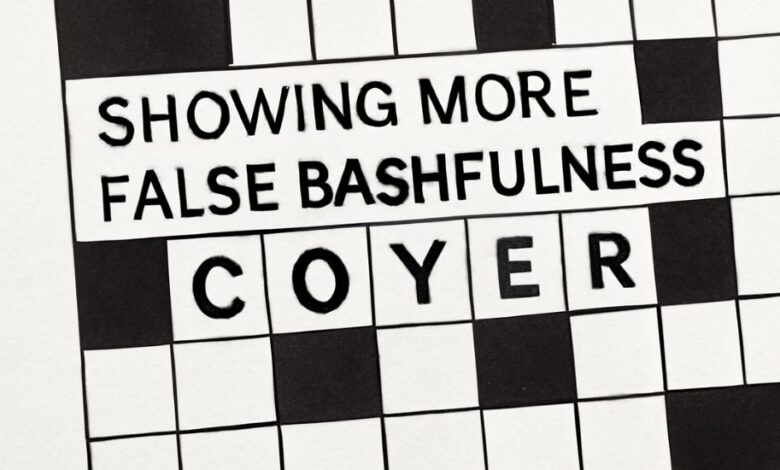
The Quick Answer: “Showing More False Bashfulness” = COYER
The correct answer to the crossword clue “showing more false bashfulness” is:
COYER (5 letters)
This appears in several crossword dictionaries and major puzzle archives. But more importantly, the answer makes perfect sense when we examine the structure of the clue.
Understanding the Clue: Breaking Down the Language
Crossword clues—especially those in higher-level publications—often rely on wordplay or layered meaning. The clue “showing more false bashfulness” is a prime example of a clue that looks simple but actually hides a major linguistic twist.
Let’s break it into parts:
1. “Bashfulness”
This refers to shyness, modesty, or timidity. In everyday language, it means someone who is genuinely shy or easily embarrassed.
2. “False bashfulness”
Here is where things get interesting. “False” is the key word that transforms the meaning.
False bashfulness ≠ genuine shyness.
It means pretended modesty—acting shy on purpose, often for effect.
This kind of behavior is typically described with the word “coy.”
Some examples:
- Someone pretending not to know the answer when they really do.
- A person acting shy to seem appealing or playful.
- A character avoiding giving direct information while appearing modest.
This tells us the base word being targeted is coy, not shy.
3. “Showing more”
This indicates a comparative adjective.
For short adjectives, English typically forms the comparative by adding -er.
Examples:
- small → smaller
- loud → louder
- coy → coyer
Thus:
coy → coyer
meaning more coy, or showing more false bashfulness.
Why “COYER” Is Correct (And Why “Shyer” Isn’t)
Many crossword solvers get misled by intuition and write SHYER at first. After all, shy → shyer, and shyness is bashfulness.
But the clue does not simply say “more bashful.”
It says “more false bashfulness.”
Let’s compare:
| Word | Meaning | Genuine or Pretended? |
|---|---|---|
| shy | genuinely timid or bashful | Genuine |
| coy | pretending to be shy; feigned modesty | Pretended (“false”) |
This distinction is the entire trick of the clue.
Therefore:
- SHYER = more genuinely shy → does not fit
- COYER = more pretendedly shy → fits perfectly
This is a classic crossword technique: using a small descriptive word (“false”) to change the entire expected base word.
A Closer Look at the Word “Coy”
To fully appreciate why “coyer” is the solution, let’s explore coy more deeply.
Definition of “coy”
- Pretending to be shy or modest to be alluring or playful
- Reluctant to reveal information
- Affectedly modest
Examples in everyday sentences:
- She gave him a coy smile, pretending she didn’t see him looking.
- He was being coy about his real intentions.
- The actress played a coyer version of the character in the sequel.
Here, coy does not reflect shyness in the emotional sense. Instead, it reflects performed or strategic modesty—making it a perfect match for false bashfulness.
Crossword clues often rely on these subtle, literary definitions.
Understanding Comparative Adjectives in Crosswords
The clue uses the phrase “showing more”, which signals the comparative grammatical form. Comparative forms are used constantly in crossword puzzles because they allow for flexible letter counts and interesting clue constructions.
Comparative form rules:
- Most one-syllable adjectives:
Add -er- tall → taller
- bold → bolder
- Adjectives ending in –y:
Replace y with i, then add -er- shy → shier/shyer
- sly → slier
- coy → coyer
- Longer adjectives:
Use “more” instead of adding -er- more beautiful
- more cautious
Because coy is a short, simple adjective, its comparative form follows rule #2.
Thus:
coy → coyer
Understanding comparative structure is a massive help in deciphering clues like the one in question.
Why This Clue Appears So Often in Crossword Searches
The phrase “showing more false bashfulness crossword” is commonly searched for several reasons:
1. The clue is grammatically tricky
“False bashfulness” is not an everyday phrase; it requires interpretation.
2. The answer (COYER) is uncommon
People rarely use the word “coyer” in casual speech.
3. Solvers frequently guess incorrectly
Many initially think the answer is shyer, then realize it doesn’t fit the crossings.
4. Clue structure is misleading
Adding “more” in a clue often triggers the comparative form—but solvers sometimes forget to check whether the base word refers to false or genuine shyness.
5. It appears in high-level crosswords
New York Times and other notable outlets love linguistic misdirection, making this clue a favorite among advanced puzzle creators.
Examples of Related Crossword Clues
Understanding similar clues helps reinforce the concept. Here are related or structurally similar clues:
- Pretending to be modest → Coy
- Affectedly shy → Coy
- More coquettish → Coyer
- Affecting modesty → Coy
- Feigning shyness → Coy
You can see the pattern:
Words like affectedly, feigning, pretending, or false often cue the idea of coyness.
How Crossword Constructors Use Words Like “Coy” and “Coyer”
Crossword constructors often choose words that:
- Have double meanings
- Represent personality traits
- Contain unusual letter pairings
- Fit neatly into 4-, 5-, or 6-letter blocks
COYER checks all of these boxes:
- It has a subtle meaning
- It is a comparative form
- It’s uncommon but linguistically correct
- It fits common puzzle lengths at 5 letters
This makes it ideal for puzzles aiming to challenge solvers without being unfair.
Tips for Solving Clues That Involve Comparatives or Descriptions
If you want to get better at solving clues like “showing more false bashfulness,” here are some strategies:
1. Identify words that signal grammar
Clues containing:
- more
- less
- increasingly
- further
- somewhat
- slightly
indicate comparative or descriptive forms.
2. Look for qualifiers like “false,” “affected,” or “feigned”
These words transform the base adjective dramatically.
3. Double-check crossing letters
Comparative forms often look strange (coyer, slier, wrier), but they fit once the crossings confirm them.
4. Remember that crossword English is wider than spoken English
Puzzle creators use rare but correct forms. For example:
- spryer
- dizziest
- coyest
- slier
If it exists in a dictionary, it’s fair game.
5. Don’t rely solely on instinct
When a clue seems obvious, pause and examine every descriptive word. That extra attention often reveals a twist.
Why This Clue Is a Perfect Example of Crossword Wordplay
The reason “showing more false bashfulness” is such a celebrated clue is because it showcases almost every type of subtle crossword craftsmanship:
Hidden meaning
“False bashfulness” → coyness, not genuine shyness.
Grammar manipulation
Using “more” to force the comparative form.
Rare word usage
“Coyer” is grammatically correct but uncommon in daily speech.
High misdirection potential
Many solvers instinctively write SHYER.
Clean, elegant construction
The clue is concise but rich in meaning—an excellent example of clever, fair puzzle design.
Extended Examples: Using The Word “Coyer” in Sentences
While rare, “coyer” is absolutely valid. Here are some examples:
- She became coyer as the interviewer pressed for details, pretending she didn’t know the answer.
- He acted even coyer than usual when asked about the surprise party plans.
- The character’s behavior in the sequel was coyer, intentionally adding a humorous tone.
Understanding how to use the word clarifies why it fits the crossword clue perfectly.
Why Many Crossword Bloggers Analyze This Clue
Many crossword commentary sites, puzzle reviews, and solving blogs discuss this clue extensively. The discussions often highlight:
- How the clue teaches solvers to pay attention to every word
- How language nuance can change the entire meaning
- How solvers should balance instinct with careful analysis
- How English comparatives can yield unexpected answers
These blogs praise the clue for being educational, satisfying, and elegantly constructed—making it a small but memorable piece of wordplay.
Final Thoughts: Mastering Clues Like “Showing More False Bashfulness”
Crossword puzzles reward curiosity, attention to detail, and a willingness to question first impressions. The clue “showing more false bashfulness” is a wonderful example of how a single adjective, modified by a thoughtful word like “false,” can shift the entire meaning and lead to a clever, uncommon answer.
The solution COYER may seem surprising at first, but once you understand:
- the meaning of coy,
- the contrast between false vs. genuine shyness,
- and the linguistic rules of comparative forms,
the answer becomes not only logical but beautifully accurate.
Next time you encounter a clue involving personality traits, emotional expressions, or grammar-based hints, remember this example. It’s a small reminder that crossword puzzles are not just about vocabulary—they’re about thinking precisely.
If you enjoyed this deep dive and want more puzzle insights, linguistic breakdowns, and clue explanations, make sure to check out Newsta, where detailed crossword discussions and thought-provoking word analyses are always waiting.
1. What is the answer to the clue “showing more false bashfulness”?
The correct answer is COYER, which means “more coy” or “more falsely modest.”
2. Why is the answer COYER and not SHYER?
Because the clue uses the word “false.”
“False bashfulness” means pretended shyness, which aligns with the word coy, not genuine shyness.
Therefore the comparative form coyer is correct.
3. What does “coy” mean?
“Coy” means pretending to be shy or modest—usually deliberately or for effect. It refers to feigned modesty, not genuine bashfulness.
4. Is “coyer” a real word?
Yes. It is the grammatically valid comparative form of coy.
Although uncommon in conversation, it is frequently used in crossword puzzles.
5. Where has this clue appeared?
This clue has appeared in multiple crossword solver databases and major puzzles, including the New York Times, where COYER is the confirmed answer.
6. Why do many solvers get confused by this clue?
Because at first glance, many interpret “bashfulness” as genuine shyness and instinctively think of shyer, but the clue’s keyword “false” changes the meaning entirely.
7. How can I spot similar tricky clues in crosswords?
Look for words like false, feigned, affected, pretending, mock, pseudo, etc. These usually hint at a word referring to artificial or performed behavior.
8. Is “coy” always negative?
Not necessarily. It can describe playful modesty, flirtatious behavior, or teasing evasiveness. The tone depends on context.
9. Are comparative forms common in crossword clues?
Yes. Clues containing “more,” “less,” “increasingly,” or “somewhat” often indicate a comparative form like -er or more + adjective.
10. What strategy helps solve clues with subtle language like this?
Focus on every descriptive word—especially qualifiers like “false.” They often shift the meaning dramatically and lead to the correct solution.