4 Square the Game: Rules, Court Dimensions, Special Variations, and How to Play Like a Pro

A Playground Legend That Still Brings People Together
Few games have stood the test of time like 4 Square the Game. With nothing more than a rubber ball, a court divided into four equal sections, and four eager players, this classic playground activity delivers endless excitement. Every serve begins a fast-paced rally where quick thinking, sharp reflexes, and smart strategy determine who rises to the coveted King square and who returns to the end of the line.
Generations of students have enjoyed Four Square during school recess, while families, community groups, and recreational leagues continue to keep the tradition alive. Its appeal lies in its simplicity. The game is easy to learn in just a few minutes, yet it offers enough depth and strategy to keep experienced players challenged. Today, interest has expanded beyond schoolyards, with people searching for four square game online, official rule guides, and creative variations that add fresh twists to every match.
Whether you’re discovering the game for the first time or looking to sharpen your skills, understanding the fundamentals is the first step. This guide begins with the history of Four Square, explains how the game is played, explores the equipment you need, and covers 4 square dimensions and rules that form the foundation of every successful game.
What Is 4 Square the Game?
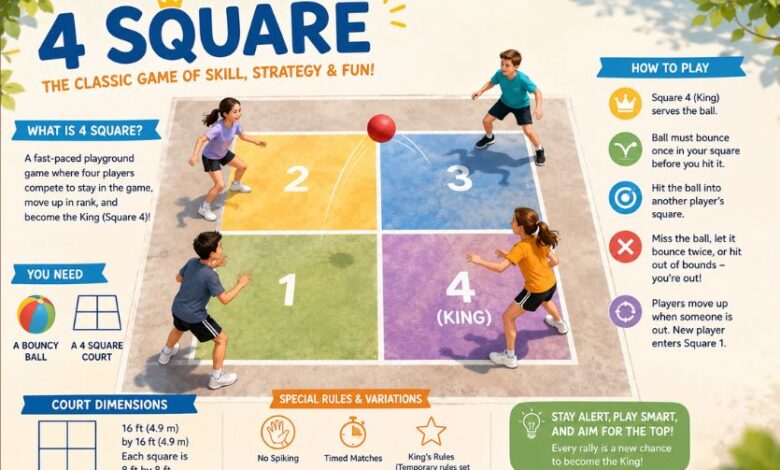
4 Square the Game is a recreational ball game played by four participants on a square court divided into four equal sections. Each player occupies one square and attempts to keep the ball in play while forcing opponents to make mistakes. Every successful return keeps a player in the game, while errors result in elimination and a change in player positions.
The court is arranged according to rankings. Square One is typically the starting position for new players, while Square Four, commonly known as the King or Ace square, is the highest-ranking position. The player in the King square serves the ball to begin each rally and tries to defend that position against challengers.
Unlike many sports that emphasize strength or endurance, Four Square rewards timing, precision, and anticipation. Players must judge the bounce of the ball, react quickly to incoming shots, and place their returns strategically to pressure opponents into making mistakes. Every rally can change the order of the court, making each point exciting from beginning to end.
Because the rules are straightforward and the equipment is inexpensive, Four Square remains one of the most accessible games for players of all ages. Schools, parks, recreation centers, and neighborhoods around the world continue to enjoy this timeless activity.
The History of Four Square
The exact origins of Four Square remain uncertain, but the game gained widespread popularity in schools across North America during the early twentieth century. Physical education teachers embraced it because it required very little equipment, encouraged constant movement, and allowed many students to participate throughout recess or class periods.
As the game spread from one school to another, different communities introduced their own interpretations of the rules. Some playgrounds encouraged gentle serves and controlled rallies, while others allowed faster, more aggressive styles of play. These local variations became part of the game’s culture, making every schoolyard slightly different while preserving the same core objective.
Over the decades, Four Square has remained a favorite playground activity despite the rapid growth of video games and digital entertainment. Organized tournaments, recreational leagues, and community competitions have helped introduce the game to new generations. The popularity of instructional videos and four square game online searches has also made learning the game easier than ever, allowing players to study techniques, understand official rules, and connect with fellow enthusiasts around the world.
Why Four Square Continues to Be Popular
Many playground games disappear over time, but Four Square has maintained its popularity because it combines simplicity with competitive excitement. Players do not need expensive equipment, large teams, or specialized facilities to enjoy the game. A ball, a marked court, and a few friends are enough to create hours of entertainment.
Another reason for its lasting appeal is that the game welcomes players of different ages and skill levels. Beginners can learn the basics within minutes, while experienced players continue developing advanced techniques that make every rally more challenging. This balance allows children, teenagers, and adults to enjoy the same game together.
Four Square also promotes valuable life skills. Every match encourages quick decision-making, patience, concentration, communication, and good sportsmanship. Players learn how to compete fairly, respect opponents, and adapt to changing situations, all while staying physically active.
Its flexibility is another major advantage. The game can be played casually during school recess, competitively in tournaments, or simply for fun during family gatherings and community events. Because local rules can easily be adjusted, every group can create a version that matches its own playing style.
Equipment Needed to Play
One of the greatest strengths of 4 Square the Game is that it requires very little equipment, making it affordable and easy to organize almost anywhere.
The most important item is the ball. A traditional 4 square ball game uses a medium-sized rubber playground ball that provides a high, consistent bounce. The ball should feel comfortable when struck with an open hand while maintaining enough air pressure to rebound evenly across the court. A properly inflated ball creates smoother rallies and allows players to control their shots with greater accuracy.
The second requirement is a flat playing surface. Concrete playgrounds are the most common choice because they produce reliable ball bounce, although asphalt courts and indoor gymnasium floors work equally well. The surface should be clean, level, and free from obstacles that might interfere with play.
Court markings complete the setup. Permanent courts are usually painted on school playgrounds, while temporary courts can be created using chalk, athletic tape, or removable markers. Because the game relies on clearly defined boundaries, visible lines are essential for fair competition.
With these simple materials in place, players are ready to begin a match that can provide hours of energetic fun.
Understanding the Court Layout
The Four Square court is designed to create balanced competition between all four players. A large square is divided into four equal sections, with one participant standing inside each square throughout the rally.
Each square represents a different rank. The lowest-ranked player begins in Square One, while the highest-ranked player occupies Square Four. The player in Square Four serves the ball to start each point and attempts to defend that position against the other competitors.
Whenever a player commits a fault and is eliminated, the remaining players move up one position. The player from Square Three advances to Square Four, Square Two moves into Square Three, and Square One advances into Square Two. A new participant then enters the lowest-ranked square to keep the game moving.
This constant rotation ensures that every rally matters. Even players who begin in the lowest position have the opportunity to climb through the rankings by playing consistently and forcing opponents into mistakes.
4 Square Dimensions and Rules
Understanding 4 square dimensions and rules is essential before learning the game’s serving techniques and scoring system. A regulation Four Square court measures approximately sixteen feet by sixteen feet, creating a large square that is divided evenly into four smaller sections. Each individual square measures about eight feet by eight feet, giving every player an equal amount of space to defend.
The boundary lines separate each player’s territory and play an important role during rallies. Depending on local or school rules, a ball landing directly on a line may be considered out of bounds or replayed. Because interpretations vary from one playground to another, players should agree on line calls before beginning the game.
Although these measurements are commonly used for official play, recreational games often adapt the court size to suit available space and player age. Younger children may enjoy smaller courts that make movement easier, while larger community courts can create longer, more strategic rallies.
Indoor courts often use removable tape instead of permanent paint, allowing schools and recreation centers to set up temporary playing areas without altering gymnasium floors. Regardless of the surface or exact measurements, maintaining four equal squares ensures that every player competes under the same conditions.
Mastering the court layout and understanding its dimensions provides the foundation for every successful match. Once these basics become familiar, learning the official rules, serving techniques, and advanced strategies becomes much easier, allowing players to enjoy the full excitement that has made Four Square a beloved playground game for generations.
Four Square Rules Every Player Should Know
Learning the official four square rules is the key to enjoying fair, competitive, and exciting matches. While schools and playgrounds often introduce their own variations, the core rules remain remarkably consistent. These basic guidelines create a balanced game where skill, timing, and strategy matter far more than strength alone.
Every match begins with four players standing in their assigned squares. The player occupying Square Four, often called the King square, serves the ball to begin play. The serve must bounce once inside the server’s square before traveling into another player’s square. Once the receiving player allows the ball to bounce once inside their own square, they must return it with an open hand into another player’s square.
Players continue exchanging shots until someone commits a fault. Whenever a player is eliminated, the remaining competitors rotate upward through the rankings, and a new player enters Square One. This constant movement keeps every rally meaningful and ensures that each participant has an opportunity to reach the highest position on the court.
Although local rules may differ slightly, agreeing on the rules before the first serve helps avoid disagreements and keeps the game enjoyable for everyone.
Serving Rules and How a Rally Begins
Every point starts with a legal serve, making the serve one of the most important parts of 4 Square the Game. Only the player in the King square has the right to serve. The server begins by bouncing the ball once inside their own square before directing it into another player’s section of the court.
A legal serve should be controlled rather than overpowering. Many schools require underhand serves to ensure fair competition and prevent stronger players from gaining an unfair advantage. The receiving player must allow the ball to bounce exactly once before returning it with an open hand. Hitting the ball before it bounces or allowing it to bounce twice results in immediate elimination.
Once the serve has been successfully returned, the rally becomes fast-paced as players direct the ball into different squares while attempting to force mistakes. Good serves are not always powerful. Experienced players often rely on accurate placement and unpredictable angles to create difficult returns without violating the rules.
Understanding proper serving technique helps beginners develop confidence while allowing advanced players to control the pace of each rally.
How Players Get Eliminated
The excitement of Four Square comes from its simple elimination system. Every mistake changes the court rankings, giving other players the opportunity to advance toward the King square.
A player is eliminated if the ball bounces twice inside their square before they return it. Stepping outside the court while making contact with the ball may also result in a fault depending on local rules. Catching the ball instead of striking it, carrying it with the hand, or holding it for too long are additional violations that usually lead to elimination.
Players must also avoid hitting the ball out of bounds. If a return lands completely outside the marked court, the player who made the shot is considered out. Some playgrounds treat balls landing directly on boundary lines as faults, while others allow play to continue. Since these interpretations vary, players should agree on line rules before the game begins.
Another common mistake involves double touching the ball. Each player is generally allowed only one clean hit before sending the ball into another square. Multiple contacts during the same return are usually considered illegal.
The elimination system keeps every rally exciting because even the highest-ranked player can quickly lose the King position after a single mistake.
Rotation After Elimination
One of the defining features of 4 Square the Game is its automatic rotation system. Whenever a player is eliminated, everyone below that player moves up one position. If the King is eliminated, the player from Square Three becomes the new King, the player from Square Two advances to Square Three, and the player from Square One moves into Square Two. A waiting player then enters Square One to fill the empty space.
This continuous movement prevents one player from dominating the court indefinitely and gives every participant the opportunity to climb the rankings through consistent performance.
Because every elimination changes the order of play, even beginners have a chance to challenge experienced competitors. This rotation system creates balanced competition and keeps everyone engaged throughout the game.
Choosing the Right Ball for a 4 Square Ball Game
A quality ball has a major influence on gameplay. A traditional 4 square ball game uses a medium-sized rubber playground ball that offers a predictable bounce and comfortable handling. The ball should be firm enough to rebound consistently while remaining soft enough for repeated contact with open hands.
An underinflated ball often produces slow, uneven bounces that interrupt the rhythm of the game. Conversely, an overinflated ball can become difficult to control and may encourage overly aggressive play. Maintaining proper air pressure allows rallies to flow naturally and rewards players who rely on accuracy rather than power.
Many schools prefer brightly colored playground balls because they are easier to track during fast-moving exchanges. A well-maintained ball improves fairness, enhances control, and creates a more enjoyable experience for players of every skill level.
4 Square in the Air Game
Among the many creative variations of Four Square, the 4 square in the air game has become one of the most exciting. Unlike the traditional version, which depends on controlled bounces inside each square, this variation places greater emphasis on aerial shots and quick reactions.
Players attempt to keep the ball moving through the air while directing it toward opponents in creative ways. Since rallies involve fewer ground bounces, participants must react more quickly and anticipate the ball’s movement with greater precision. The pace becomes noticeably faster, rewarding players with strong hand-eye coordination and excellent timing.
Rules for this variation differ from one playground to another. Some groups allow only one bounce before returning to aerial play, while others eliminate bounces altogether for short periods. Regardless of the exact format, the 4 square in the air game introduces a fresh challenge that experienced players often enjoy after mastering the traditional version.
Four Square Special Rules
One reason Four Square has remained popular for generations is the freedom to introduce creative rule variations. These four square special rules make every playground unique and encourage players to adapt their strategies throughout the game.
Many schools allow the King player to announce temporary special rules that remain active until the King is eliminated. One common example is the “No Spiking” rule, which prohibits powerful downward slams and encourages longer rallies built on accuracy and placement. Another favorite is “Baby Serves,” where every serve must be gentle enough to ensure fair play for younger participants.
Some playgrounds introduce the “Around the World” rule, requiring players to direct the ball into every square before targeting the same opponent again. Others experiment with creative challenges such as using only the non-dominant hand or limiting the height of each return.
These variations prevent matches from becoming predictable. Players must quickly adjust their tactics whenever new rules are introduced, making every game feel different from the last.
Strategy for Staying in the King Square
Reaching the King square is an achievement, but remaining there requires careful strategy. Successful players avoid relying solely on powerful hits because aggressive shots often lead to unnecessary mistakes. Instead, they focus on consistency, ball placement, and reading their opponents’ movements.
Experienced players watch how opponents position themselves before deciding where to direct each return. A well-placed shot into an open area often proves more effective than a powerful strike aimed directly at another player. Controlling the pace of the rally also helps reduce errors while forcing opponents to react under pressure.
Maintaining balance is equally important. Players who stay centered within their squares can respond more effectively to unexpected bounces and angled shots. Quick footwork, steady concentration, and controlled hand movements allow experienced competitors to defend the King position for extended periods.
In the final part of this guide, you’ll discover exciting four square mini games, learn about four square game online options, explore where to find a 4 square game rules PDF, and uncover practical tips that will help players of every skill level enjoy this timeless playground classic even more.
Four Square Mini Games That Make Every Match More Exciting
Once players become comfortable with the traditional format, introducing four square mini games is a great way to keep every session fresh and challenging. These creative variations encourage players to develop new skills while adding variety to familiar gameplay.
One popular mini game is the King Challenge, where every player focuses on defeating the King without worrying about long-term rankings. Another favorite is Speed Round, which encourages faster serves and quicker returns, testing reaction time and decision-making under pressure. Some groups enjoy playing with only their non-dominant hand, forcing everyone to rely on control instead of strength. Others introduce a One-Hand Challenge, where players must return every shot using the same hand throughout the match.
Timed matches are another enjoyable variation. Instead of playing until a certain number of eliminations, participants compete to see who can remain in the King square for the longest period before time expires. These mini games keep experienced players engaged while helping beginners improve important skills in a relaxed environment.
Because every playground develops its own traditions, players are encouraged to experiment with new challenges that maintain fairness while making each game unique.
Four Square Game Online
Although Four Square was originally designed as an outdoor playground activity, modern technology has introduced new ways to enjoy the game. Searching for four square game online reveals browser-based games, educational simulations, and multiplayer adaptations inspired by the traditional experience.
Online versions allow players to learn the mechanics before stepping onto a real court. Many games include tutorials that explain serving, court positioning, and elimination rules, making them useful for beginners who want to understand the basics at their own pace.
Some online versions also feature artificial intelligence opponents with different difficulty levels, allowing players to practice strategy and timing. Others include multiplayer modes where friends can compete remotely using computers or mobile devices.
While digital versions cannot fully replicate the excitement of playing on a real court with friends, they offer a convenient way to practice, introduce new players to the game, and enjoy Four Square when outdoor play is not possible.
Finding a 4 Square Game Rules PDF
Teachers, coaches, and recreation leaders often look for a 4 square game rules PDF to simplify instruction and ensure everyone follows the same guidelines. Printable rule sheets are especially helpful during physical education classes, youth camps, after-school programs, and organized tournaments.
A typical rules PDF includes court diagrams, serving instructions, player rotation, common fouls, elimination procedures, and official court measurements. Many also provide illustrations that help beginners understand player positions and the flow of the game.
Having a printed copy available before play begins reduces confusion and minimizes disagreements during matches. Since local rule variations are common, organizers may customize their own versions while keeping the core principles of Four Square intact.
Whether used in schools or recreational leagues, a clear rules guide helps create fair competition and allows new players to learn the game more quickly.
Tips for Beginners
Every experienced Four Square player started as a beginner, and mastering the game begins with developing good habits. New players should focus on consistency rather than power. A controlled return that lands safely inside another player’s square is often more effective than a hard shot that travels out of bounds.
Watching the bounce of the ball is equally important. Anticipating where the ball will land allows players to move into the correct position before making contact. Keeping the knees slightly bent and remaining balanced helps improve reaction time during fast rallies.
Beginners should also avoid standing too close to the edges of their squares. Staying near the center provides more time to react to unexpected shots while making it easier to defend every corner of the court.
Practice is the greatest teacher. The more rallies players complete, the more comfortable they become with timing, placement, and reading opponents’ movements.
Advanced Strategies for Experienced Players
As skill levels improve, Four Square becomes increasingly strategic. Successful players learn to disguise their intentions by looking in one direction while striking the ball into another. This simple technique often catches opponents off guard and creates easy opportunities for elimination.
Controlling the speed of the game is another valuable strategy. Instead of hitting every return with maximum force, experienced competitors mix slow, controlled shots with occasional faster returns to keep opponents guessing. Changing the pace forces other players to adjust continuously, increasing the likelihood of mistakes.
Court awareness also separates advanced players from beginners. Skilled competitors constantly observe where opponents are standing before choosing their target. Directing the ball toward open space rather than directly at another player often produces better results.
Patience is equally important. Many rallies are won because one player remains calm while others rush difficult shots. Staying composed under pressure allows experienced competitors to defend the King square for longer periods.
Benefits of Playing Four Square
Beyond its entertainment value, 4 Square the Game offers numerous physical, mental, and social benefits that make it an excellent activity for players of all ages.
Physically, the game improves agility, coordination, balance, hand-eye coordination, and reaction speed. Constant movement during rallies keeps players active while encouraging healthy exercise without the structure of formal athletic training.
Mentally, Four Square strengthens concentration, problem-solving abilities, and decision-making skills. Every return requires players to evaluate the court, anticipate opponents’ actions, and choose the most effective response within seconds.
Socially, the game promotes teamwork, communication, fairness, and respect for others. Because players rotate continuously, everyone has opportunities to compete against different opponents, helping build friendships and encouraging positive sportsmanship.
Teachers and recreation leaders appreciate Four Square because it combines physical activity with valuable life skills in an enjoyable and inclusive environment.
Frequently Asked Questions
Is Four Square suitable for adults?
Absolutely. Although Four Square is often associated with school playgrounds, adults regularly enjoy the game during recreational events, community gatherings, and organized competitions. The simple rules and strategic gameplay make it enjoyable for every age group.
How many players are needed?
A standard game requires four players on the court at one time. Additional participants usually wait in line and enter the game whenever someone is eliminated.
Can Four Square be played indoors?
Yes. Gymnasiums provide an excellent playing surface, especially when temporary court lines are created using athletic tape. Indoor play also allows games to continue during poor weather.
Are there official rules?
Yes, but many schools and communities create their own local variations. Before beginning a match, players should agree on serving rules, line calls, and any special rules that will be used throughout the game.
Is Four Square good for children?
Yes. The game helps children improve coordination, confidence, teamwork, communication, and physical fitness while encouraging active play and friendly competition.
Conclusion
4 Square the Game has earned its reputation as one of the world’s most beloved playground activities through its perfect combination of simplicity, strategy, and excitement. With only a rubber ball, a marked court, and four players, the game creates endless opportunities for friendly competition while helping participants develop coordination, quick thinking, and sportsmanship.
Whether you’re learning the four square rules, exploring 4 square dimensions and rules, trying a new 4 square in the air game, experimenting with four square special rules, enjoying creative four square mini games, downloading a 4 square game rules PDF, or practicing through a four square game online, every version captures the same timeless spirit that has entertained generations.
The lasting appeal of Four Square lies in its ability to bring people together regardless of age or experience. Every rally offers a new challenge, every rotation creates another opportunity, and every match reminds players that some of the greatest games are also the simplest. Whether played on a school playground, at a neighborhood park, or during a family gathering, Four Square continues to prove that a classic game never goes out of style.